
Introduction
Seattle's housing market is one of the most competitive — and unforgiving — in the country. With home prices between $800K and $1.2M, even a single mistake can cost you $30,000 to $150,000 or more. Whether you're a first-time buyer or an experienced homeowner, the risks are real. This guide covers the 15 most costly house buying mistakes Seattle buyers make in 2026 — and exactly how to avoid them.
Quick Answer: Most Costly House Buying Mistakes in Seattle
The most common house buying mistakes in Seattle include:
- Overbidding in competitive markets — emotional bidding wars cost buyers $30K–$100K
- Waiving inspection on older homes — hidden defects create $10K–$30K in undetected risk
- Choosing location based only on price — wrong neighborhood creates a $50K–$150K resale gap
These mistakes are driven by emotional decisions, lack of local data, and poor financial planning — and are largely avoidable with the right strategy.
Why House Buying Mistakes in Seattle Are So Costly in 2026
Buying a home in Seattle has never been more unforgiving. With median home prices hovering between $800,000 and $1.2 million, even a small miscalculation can translate into a five- or six-figure financial loss — not over a decade, but within the first few years of ownership.
Seattle's housing market is uniquely punishing for unprepared buyers. Four compounding factors set it apart from most U.S. cities:
- Extreme price levels — At $800K–$1.2M, every percentage point of error is magnified into tens of thousands of dollars
- Intense competition — Bidding wars are common, pushing buyers toward emotional, reactive decisions
- Aging housing stock — Many Seattle homes date to the 1920s–1960s, carrying hidden repair risks that newer markets don't face
- Interest rate lock-in — In a high-rate environment, a wrong mortgage decision compounds over 30 years
Most first-time buyers — and even experienced ones — walk into the Seattle housing market focused on winning. The smartest buyers, however, are focused on not losing.
In Seattle, even small house buying mistakes can compound into six-figure long-term losses. This guide walks you through the 15 most costly errors Seattle buyers make in 2026, and exactly how to avoid every one of them.
Top 15 Costly House Buying Mistakes in Seattle (And How to Avoid Them)
These 15 house buying mistakes in Seattle are the most common reasons buyers lose $30,000–$150,000 in avoidable costs.
In a high-priced and competitive market like Seattle, small decision errors—such as overbidding, skipping inspections, or choosing the wrong location—can quickly turn into major financial losses. Below is a breakdown of the 15 most costly mistakes Seattle buyers make and how to avoid each one before making an offer.
Mistake 1: Overbidding in Seattle's Competitive Market
Overbidding is the most common house buying mistake in Seattle, often costing buyers $30,000–$100,000 due to emotional bidding wars.
- ❌ The mistake: Emotional bidding wars without a pre-defined ceiling
- 💸 The cost: $30,000–$100,000+ in overpayment
- ✅ The fix: Use 30–60 day closed comps and set a firm maximum before touring
This house buying mistake consistently tops the list because Seattle's market generates multi-offer situations that push buyers past rational limits. Emotional bidding wars are the single fastest way to overpay by $30,000 to $100,000 or more.
The problem isn't that buyers don't know the risks — it's that they haven't defined their ceiling before the emotion kicks in. Once you're standing in a beautifully staged Craftsman in Ballard, surrounded by other eager buyers, your rational mind steps aside.
The fix: Pull comparable sales from the last 30–60 days before touring. Set a firm maximum bid in writing. Treat it as non-negotiable. If the home requires exceeding that number, walk away — Seattle has inventory, and another opportunity will come.
Maggie's insight: Many Seattle buyers overpay not because of price — but because they don't define their max before bidding. Set your ceiling before you fall in love with the home.
Mistake 2: Waiving Inspection on Older Seattle Homes
Waiving inspection is a costly house buying mistake in Seattle's older housing market, exposing buyers to $10,000–$30,000 in undetected repair risk.
- ❌ The mistake: Skipping inspection on older Seattle homes to win offers
- 💸 The cost: $10,000–$30,000+ in undetected repairs
- ✅ The fix: Pre-inspect before bidding, or use a material-defects-only contingency
In competitive markets, buyers are often pressured to waive the home inspection to strengthen their offer. In Seattle, this house buying mistake is particularly dangerous — and financially punishing.
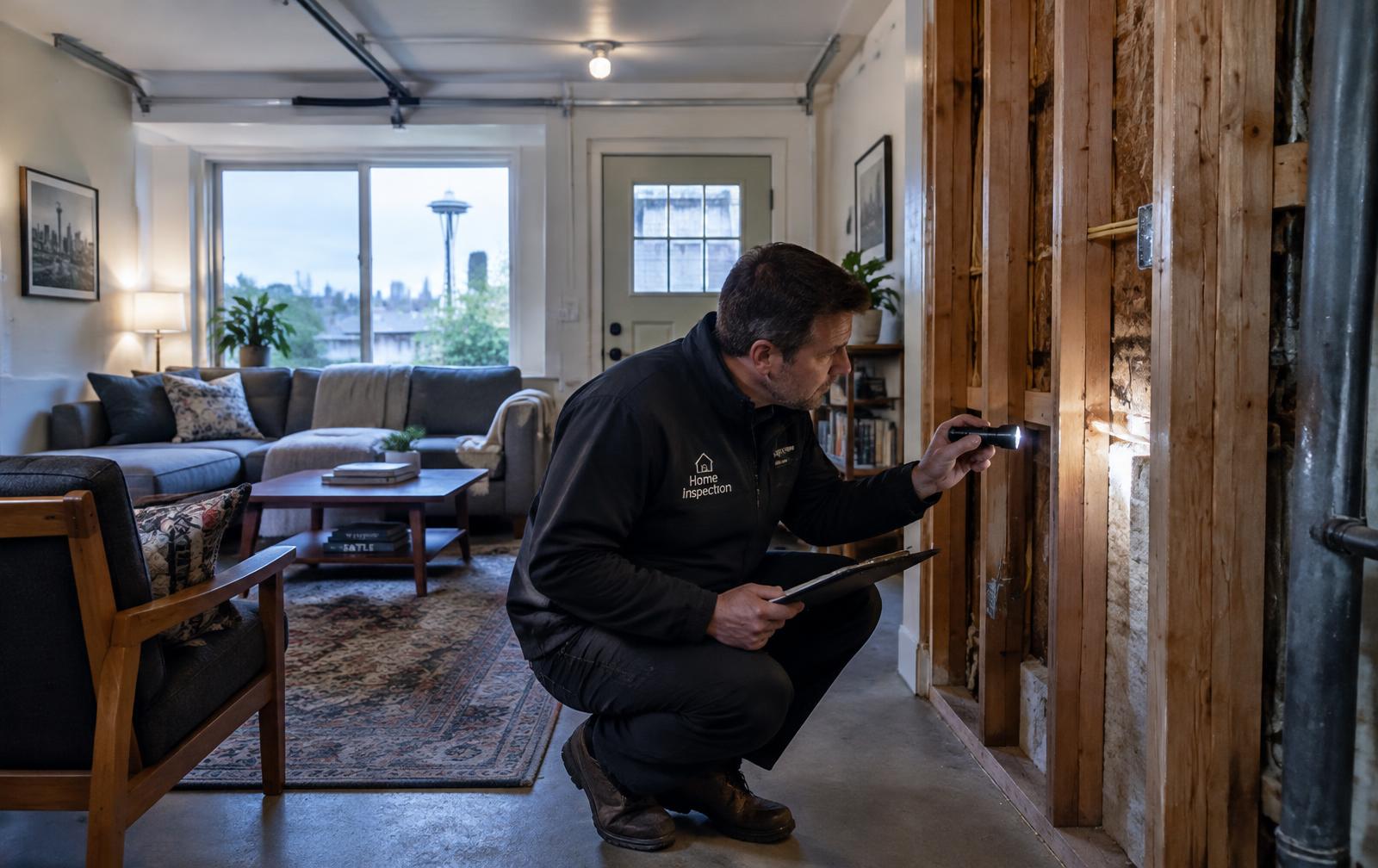
Seattle's housing stock skews older. Many homes in Capitol Hill, Queen Anne, Madrona, and Columbia City were built between the 1920s and 1960s. These homes commonly carry hidden issues:
- Aging sewer lines vulnerable to root intrusion
- Galvanized plumbing near end of useful life
- Deteriorating roofs with limited remaining lifespan
- Inadequate electrical panels (60-amp service, knob-and-tube wiring)
- Moisture infiltration from the region's relentless rain and poor historic ventilation
A single undiscovered problem — a failing sewer lateral, a mold issue in a poorly ventilated crawl space — can easily cost $10,000 to $30,000 to remediate.
The fix: Consider a pre-inspection before submitting your offer. Many Seattle sellers will accommodate this if you pay for it upfront. Alternatively, structure your offer with an inspection contingency framed around material defects only, rather than a full right to cancel — this keeps you competitive while protecting against catastrophic surprises.
Mistake 3: Underestimating Total Monthly Home Costs
Underestimating total monthly costs is a house buying mistake that routinely leaves Seattle buyers $1,000–$2,000 short every month after closing.
- ❌ The mistake: Budgeting only for the mortgage payment
- 💸 The cost: $1,000–$2,000/month in recurring miscalculation
- ✅ The fix: Model the full total cost of ownership before shopping
This mistake costs buyers not just at purchase — it strains finances throughout the ownership period. First-time buyers in particular treat the mortgage payment as the full cost of ownership, leading to a $1,000 to $2,000 per month miscalculation in Seattle's high-tax, high-maintenance market.
Consider what a realistic monthly cost breakdown looks like on a $950,000 Seattle home:
| Cost Component | Estimated Monthly Amount |
| Mortgage (principal + interest, 6.8%, 20% down) | ~$5,200 |
| Property taxes (King County) | ~$700–$900 |
| Homeowner's insurance | ~$150–$250 |
| HOA fees (if applicable) | $300–$1,000+ |
| Maintenance reserve (1% annually) | ~$500–$800 |
| Utilities | ~$200–$400 |
| Realistic Total | ~$7,050–$8,550+/month |
The fix: Build a complete total cost of ownership model before you begin shopping. Not after you've found your dream home — before. Know your true number, not your mortgage number.
Mistake 4: Ignoring HOA Financial Health in Seattle Condos
Ignoring HOA financial health is a house buying mistake that can trigger surprise special assessments of $10,000–$50,000 in Seattle condo buildings.
- ❌ The mistake: Not reviewing HOA reserve studies before buying a condo
- 💸 The cost: Special assessments of $10,000–$50,000 per unit
- ✅ The fix: Request reserve study, meeting minutes, and current funding percentage
Seattle's condo market carries a hidden landmine that catches thousands of buyers off guard: the special assessment. When an HOA's reserve fund is underfunded — common in older Seattle buildings — major repairs become the buyer's problem, not the building's.
Common triggers in Seattle condo buildings include:
- Failing roofs on mid-rise buildings
- Elevator replacement
- Seismic retrofitting requirements
- Exterior re-cladding (especially in wood-frame buildings)
- Parking garage structural repairs
These projects can generate special assessments of $10,000 to $50,000 per unit, often due within 60 to 90 days of approval.
The fix: Before making an offer on any Seattle condo, request the HOA's reserve study, meeting minutes from the past two years, and the current reserve fund balance. Look for a reserve funding percentage above 70%. Anything below 50% is a warning sign.
Mistake 5: Choosing Location Based Only on Price
Choosing location based only on price is a house buying mistake that creates a $50,000–$150,000 long-term resale gap in Seattle's neighborhood-specific market.
- ❌ The mistake: Prioritizing affordability over long-term location value
- 💸 The cost: $50,000–$150,000 resale gap vs. a better-located comparable
- ✅ The fix: Evaluate school district, commute access, and neighborhood demand trends
In a high-cost market like Seattle, it's tempting to stretch toward more affordable neighborhoods. But this house buying mistake compounds over time — wrong location choices don't just affect quality of life, they directly erode resale value.
Seattle's appreciation is intensely neighborhood-specific. Evaluate each neighborhood on three dimensions:
- School district quality — Even if you don't have children, your future buyer likely will. See our Seattle school districts guide.
- Commute access — Proximity to I-5, SR-520, or Link Light Rail directly affects buyer demand
- Historical demand patterns — Neighborhood-level price-per-square-foot trends, not city-wide averages
For a deeper neighborhood comparison, see our best neighborhoods in Seattle guide.
Mistake 6: Misjudging Commute Time in Seattle Traffic
Misjudging commute is a house buying mistake in Seattle that reduces long-term resale demand and narrows your future buyer pool.
- ❌ The mistake: Trusting map distance instead of real peak-hour commute time
- 💸 The cost: Reduced buyer pool and resale value; quality-of-life toll
- ✅ The fix: Test drive your commute at 7:30 AM on a weekday before offering
This house buying mistake quietly destroys resale value over time. Seattle consistently ranks among the worst U.S. cities for traffic congestion — a home that appears 8 miles from downtown can mean a 45-to-75-minute commute during peak hours. Buyers who don't account for this find themselves holding a property that future buyers will discount.
The fix: Test your actual commute route at 7:30 AM on a Tuesday before submitting any offer. Use Google Maps in real-time, not estimated times. Consider what happens to your commute tolerance if your work policy changes. If you're weighing suburban options, our affordable cities near Seattle guide includes commute context for each area.
Mistake 7: Ignoring School District Impact on Resale
Ignoring school district quality is a house buying mistake in Seattle that costs sellers a 5%–15% resale premium — even if they never had children.
- ❌ The mistake: Dismissing school quality as irrelevant to non-parents
- 💸 The cost: 5%–15% resale premium gap vs. homes in top districts
- ✅ The fix: Cross-reference school district boundaries on every address you tour
This house buying mistake is especially common among investors and young couples who dismiss schools as irrelevant to their situation. In Seattle, homes within the boundaries of high-performing districts like Shoreline, Bellevue, or certain Seattle Public Schools clusters can command a 5% to 15% premium at resale compared to structurally identical homes just outside those boundaries (National Bureau of Economic Research).
You may not have children today. Your buyer in six years likely will.
The fix: Cross-reference the home's address with school district boundary maps before making a decision. GreatSchools ratings provide a useful starting framework. Review our full Seattle school districts breakdown to understand which boundaries carry the most resale weight.
Mistake 8: Waiting for a Market Crash That May Not Come
Waiting for a market crash is a house buying mistake in Seattle that costs buyers $50,000–$150,000 in missed appreciation and rent paid during the delay.
- ❌ The mistake: Delaying purchase while waiting for prices to fall
- 💸 The cost: $50,000–$150,000 in missed appreciation + rent paid while waiting
- ✅ The fix: Evaluate long-term affordability over a 7+ year hold, not short-term timing
This house buying mistake is driven by logic that feels sound — prices are high, rates are elevated — but ignores Seattle's structural market dynamics. Constrained land supply, strong tech employment, and consistent in-migration have supported long-term price appreciation through every rate cycle. According to Zillow Research, Seattle home values have appreciated an average of 5–7% annually over the past decade, despite short-term corrections.
The opportunity cost of waiting in Seattle ranges from $50,000 to $150,000 when you factor in appreciation missed plus rent paid during the waiting period.
The fix: Stop trying to time the market and start evaluating affordability on a long-term basis. The question isn't "Is now the best time to buy?" — it's "Can I afford to hold this home for 7+ years?" For current context, see our Seattle real estate outlook and is buying a house in Seattle a good investment?
Mistake 9: Not Using Real Comparable Sales (Comps)
Not using real comparable sales is a house buying mistake that leads to systematic overpaying in Seattle's hyperlocal, boundary-sensitive market.
- ❌ The mistake: Relying on Zestimates or list price trends instead of closed data
- 💸 The cost: Systematic overpaying on every offer
- ✅ The fix: Request a formal CMA using only 30–60 day closed sales in your micro-neighborhood
This house buying mistake is harder to see in the moment — but its cost is real. Too many buyers rely on Zestimate valuations or neighborhood reputation when determining what a home is worth, when the data that actually matters is much more precise.
A true comparable sales analysis filters by:
- Closed transactions in the past 30–60 days only
- Matching square footage (±15%), bedroom/bath count, and condition
- Micro-location — In Seattle, one block, one arterial, or one school district boundary can move value by 5–10%
The fix: Ask your agent to prepare a formal CMA for every home you're seriously considering. If any comparable is older than 90 days or more than half a mile away, ask why.
Mistake 10: Choosing the Wrong Mortgage Loan Structure
Choosing the wrong loan structure is a house buying mistake in Seattle that costs buyers $20,000–$80,000 in excess interest — simply by not comparison shopping.
- ❌ The mistake: Accepting the first loan product offered without comparison shopping
- 💸 The cost: $20,000–$80,000 in excess interest over the loan term
- ✅ The fix: Compare quotes from 3+ lenders; model both fixed and ARM scenarios
This house buying mistake is entirely avoidable. In a market where purchase prices regularly exceed $900,000, even a 0.25% rate difference compounds into tens of thousands of dollars over the loan term (Consumer Financial Protection Bureau).
Key decisions to evaluate:
| Decision | When to Consider |
| 30-year fixed | If you plan to hold 7+ years and value payment certainty |
| 5/1 or 7/1 ARM | If you plan to sell or refinance within 5–7 years |
| Jumbo vs. conforming | Most Seattle homes exceed conforming limits — rates and terms differ |
| 20% down vs. less | PMI costs vs. preserving liquid cash reserves |
The fix: Get quotes from at least three lenders — including a mortgage broker who can access multiple wholesale products. Model both fixed and ARM scenarios based on your actual anticipated holding period. Read our Seattle home buying guide for a full financing walkthrough.
Mistake 11: Underestimating Maintenance in Older Homes
Underestimating maintenance is a house buying mistake in Seattle that quietly drains $10,000–$20,000 per year from buyers of older homes.
- ❌ The mistake: Not budgeting for Seattle's climate-driven maintenance demands
- 💸 The cost: $10,000–$20,000+ annually on older homes
- ✅ The fix: Build a five-year capital expenditure forecast before closing
This house buying mistake hits hardest in Seattle's aging housing stock, where the wet climate accelerates wear in ways buyers from drier regions simply don't anticipate.
- Wood rot — Siding, trim, deck boards, and fence posts degrade faster than in dry climates
- Roof wear — Moss growth and persistent moisture reduce roof lifespan significantly
- Paint failure — Exterior repaints may be needed every 5–7 years vs. 10+ in drier regions
- Foundation drainage — Seattle's clay soils and slope-heavy lots create ongoing drainage maintenance needs
Industry standard budgeting allocates 1% of home value annually for maintenance. On an $850,000 Seattle home, that's $8,500/year. Older homes often run 1.5%–2% (Harvard Joint Center for Housing Studies).
The fix: Before closing, have your inspector estimate remaining useful life on all major systems (roof, furnace, water heater, sewer). Build a five-year capital expenditure forecast. If the numbers don't work within your budget, walk away.
Mistake 12: Buying a Low-Liquidity Property
Buying a low-liquidity property is a house buying mistake in Seattle that creates a $20,000–$100,000 resale discount when it comes time to sell.
- ❌ The mistake: Overlooking resale-limiting property characteristics
- 💸 The cost: $20,000–$100,000 resale discount vs. conventional comparable
- ✅ The fix: Before buying, ask who your future buyer will be and what they'd object to
This house buying mistake is invisible at purchase but punishing at resale. Not all Seattle homes sell equally fast or easily — certain property characteristics reliably reduce the buyer pool and force price concessions.
- Awkward or non-functional floor plans
- Bedrooms accessible only through other bedrooms
- Location on a high-traffic arterial (Aurora Ave, Rainier Ave, Lake City Way)
- Steep lot with limited usable outdoor space
- Ground-floor condo units facing parking garages or mechanical rooms
- Homes beneath flight paths affected by SeaTac or Boeing Field traffic
The fix: Before buying, mentally put yourself in the seller's seat. Who would buy this home in 3–5 years? What would they object to? Would they need a significant discount to overlook those objections? If yes, price in that discount now — or choose a different property.
Mistake 13: Forgetting Closing Costs
Forgetting closing costs is a house buying mistake in Seattle that blindsides buyers with $15,000–$30,000 in cash they didn't budget for.
- ❌ The mistake: Planning for down payment only, not total cash to close
- 💸 The cost: $15,000–$30,000 in unexpected upfront expenses
- ✅ The fix: Ask for a Loan Estimate on day one; budget 2–3% of purchase price for closing costs
This house buying mistake is entirely preventable, yet it catches a surprising number of Seattle buyers — especially first-timers — at the worst possible moment: days before closing.
- Lender origination and underwriting fees
- Title insurance (buyer's and lender's policies)
- Escrow/closing fees
- Prepaid property taxes (often 2–6 months at closing)
- Homeowner's insurance prepaid at closing
- Recording fees and transfer taxes
Buyers who haven't budgeted for these costs sometimes have to scramble at closing, drain emergency funds, or request seller concessions that weaken their offer position.
The fix: Ask your lender for a Loan Estimate on day one. Include closing cost estimates in your total cash-to-close calculation before you begin touring homes. A good rule of thumb: budget 2–3% of the purchase price in closing costs in addition to your down payment.
Mistake 14: Relying Only on Zillow or Redfin Data
Relying only on Zillow or Redfin is a house buying mistake in Seattle that causes buyers to miss the hyperlocal signals that most impact pricing and neighborhood trajectory.
- ❌ The mistake: Making neighborhood and offer decisions based on platform data alone
- 💸 The cost: Wrong neighborhood selection; missed market intelligence
- ✅ The fix: Combine platform data with a local agent and in-person open house intel
This house buying mistake costs buyers in ways that are hard to quantify until resale — wrong neighborhood selection, overpaying on an algorithmically mispriced property, or missing off-market opportunities entirely. Online platforms are powerful tools, but not substitutes for local intelligence.
- Off-market and coming-soon inventory
- Micro-neighborhood shifts (a block that's rapidly improving vs. plateauing)
- The reason a home has been sitting unsold for 45+ days
- Local agent relationships and off-market deal flow
Buyers who make neighborhood selections and offer decisions based primarily on platform data are missing the layer of intelligence that determines whether a block is improving, stable, or declining.
The fix: Use Zillow and Redfin for initial research, but pair them with an agent who specializes in your target neighborhoods. If you're looking for experienced local representation, see our guides to the best realtors in Seattle, how to choose a realtor in Seattle, and best Chinese realtors in Seattle if you prefer working with a bilingual agent.
Maggie's insight: Online listings show data — but not neighborhood behavior shifts. The most important signals in Seattle's market are hyperlocal and often invisible to any algorithm.
15. No Clear Buying Strategy (Reactive Buying)
Having no clear buying strategy is the house buying mistake that underlies nearly every other error on this list — and it costs Seattle buyers more than any single mistake.
- ❌ The mistake: Entering the market without a documented plan
- 💸 The cost: Overpaying, missed opportunities, buyer's remorse
- ✅ The fix: Define must-haves, deal-breakers, maximum price, and target neighborhoods before your first tour
This house buying mistake is the root cause. Buyers entering the Seattle market without a data-driven plan define criteria loosely, adjust them emotionally as tours progress, and ultimately make decisions reactively — responding to what's available rather than pursuing what's right.
Reactive buying leads to:
- Overpaying because excitement overrides the budget
- Compromising on factors that actually matter long-term (location, layout, condition)
- Missing the right property because there was no framework for recognizing it quickly
The fix: Before your first tour, document:
- Your must-have features (non-negotiable)
- Your deal-breakers (automatic walk-aways)
- Your maximum bid (set in writing, not revised under pressure)
- Your target neighborhoods with specific reasoning
- The conditions under which you will walk away from any deal
Then stick to the plan. For a full buying framework, see our comprehensive Seattle home buying guide.
Home Buying Mistakes Checklist — What Seattle Buyers Must Avoid
Use this checklist before submitting any offer on a Seattle home. If you can't answer these questions confidently, you're likely exposed to at least one of the mistakes above.
- ☐ Have I verified this price against comparable closed sales from the past 30–60 days?
- ☐ Do I know the complete total monthly cost — including taxes, insurance, HOA, and maintenance?
- ☐ Have I identified the major hidden risks in this specific property (roof, sewer, mold, electrical)?
- ☐ Have I evaluated the long-term resale demand for this property type and location?
- ☐ Have I reviewed the HOA's reserve funding and meeting minutes (if applicable)?
- ☐ Have I test-driven the commute at peak hours on a weekday?
- ☐ Have I checked the school district and its impact on future resale value?
- ☐ Have I compared at least three loan structures with multiple lenders?
- ☐ Do I have a five-year capital expenditure estimate for this home's systems?
- ☐ Have I confirmed I have sufficient cash for both down payment and closing costs?
If you can't answer these clearly, you're likely making a costly mistake.
How Much Money Seattle Buyers Lose From House Buying Mistakes
Understanding the financial stakes makes these risks concrete. The table below represents estimated financial impact based on Seattle market conditions in 2026, drawing on local transaction data and industry research from the National Association of Realtors and Harvard Joint Center for Housing Studies.
| Mistake | Estimated Financial Impact |
| Overbidding in competitive situations | $30,000 – $100,000 |
| Waiving inspection on older Seattle home | $10,000 – $30,000 |
| Wrong location / low-demand neighborhood | $50,000 – $150,000 |
| HOA special assessments (underfunded reserves) | $10,000 – $50,000 |
| Buying low-liquidity property | $20,000 – $100,000 |
| Market timing / opportunity cost of waiting | $50,000 – $150,000 |
| Suboptimal loan structure | $20,000 – $80,000 |
| Underestimating maintenance costs | $8,000 – $20,000/year |
| Forgetting closing costs | $15,000 – $30,000 |
Most Seattle home buying mistakes result in $50,000–$150,000 in long-term financial impact. The compounding effect of multiple overlapping mistakes can easily push total losses well above $200,000 over a typical ownership period.
For a broader view of what drives these numbers, see our Seattle housing market analysis and the February 2026 Seattle housing market report.
How to Avoid Costly House Buying Mistakes in Seattle
The 15 house buying mistakes in this guide — from overbidding and skipped inspections to wrong location choices and reactive buying — share one root cause: entering Seattle's market without a clear, data-driven strategy. Each mistake is avoidable. Together, they can cost you $150,000 or more.
The smartest Seattle buyers don't find the perfect home — they avoid the most expensive mistakes.
Ready to buy without the costly errors? Contact Maggie Sun Real Estate Group — ranked Top 5 in Seattle — for a strategy-first consultation.
Ready to Buy in Seattle? Start With the Right Team.
Working with an experienced local agent is the single most effective way to avoid the mistakes in this guide. Maggie Sun Real Estate Group has been ranked among the Top 5 Seattle real estate teams in 2025 and recognized among the best Seattle realtors by expert review.
Additional resources from Maggie Sun Real Estate Group:
- Complete Seattle Home Buying Guide
- Seattle vs. Bellevue: Which City to Buy In?
- Best Neighborhoods in Seattle
- Should I Move to Seattle?
- Best Cities to Retire in Washington State
- 10 Best Cities to Live in Washington State
FAQ — First Time Home Buyer Mistakes in Seattle
What are the most common first time home buyer mistakes in Seattle?
The three most costly are: overbidding due to emotional bidding wars, skipping or waiving the home inspection, and underestimating total monthly ownership costs beyond the mortgage payment. Each of these mistakes is preventable with the right preparation.
What are the most costly home buying mistakes specific to Seattle?
Beyond the universal mistakes, Seattle-specific risks include: buying in an HOA with underfunded reserves (common in older condo buildings), ignoring older-home maintenance costs driven by Seattle's wet climate, and choosing location based on price rather than long-term resale demand in a hyperlocal market.
How do I avoid mistakes when buying a house in Seattle?
The most effective protection is having a clear buying strategy before you begin touring: establish your maximum bid based on real comps, calculate total monthly costs including maintenance reserves, and evaluate every property through the lens of resale potential — not just how much you like it today.
Why do Seattle buyers so often overpay?
Competition and emotional pressure. Seattle's persistent low inventory relative to demand creates multi-offer situations where buyers who haven't pre-defined their ceiling get pulled into escalating bidding wars. The fix is simple in principle but requires discipline: define your maximum before you fall in love with a property.
What is the single biggest mistake in Seattle real estate?
Entering the market without a clear, documented buying strategy. Reactive buyers — those who define their criteria loosely and adjust them emotionally as tours progress — make nearly every other mistake on this list as a downstream consequence. Strategy first, search second.
Maggie Sun
Managing Broker | Buy, Sell & Invest Seattle & Bellevue | Maggie Sun Real Estate Group
or another way