
Categories
englishPublished February 2, 2026
Buying a House in Seattle (2026): The Ultimate Local Guide
Introduction
The Seattle real estate landscape in 2026 has entered a "Great Housing Reset." For the first time in a decade, income growth in the Puget Sound is outpacing home price appreciation, creating a unique window for those looking to buy a house in Seattle Washington. While the market remains competitive, the frantic bidding wars of the past have been replaced by a more stable environment where buyers can actually conduct due diligence.
At Maggie Sun Real Estate Group, we’ve spent over 10 years helping clients navigate this tech-driven terrain. Whether you are a first-time buyer leveraging RSU income or a seasoned investor, this guide provides the 10-step roadmap and data-supported strategy you need to win in 2026.
Seattle Real Estate Market Trends in 2026
As of early 2026, according to recent NWMLS data, the city-wide median sale price for a single-family home is approximately $872,000, with inventory levels hovering around 2.5 months of supply. For buyers planning to buy a house in Seattle Washington, this shift marks the first truly strategic window since 2019—where pricing, inventory, and income growth are finally realigning.
Unlike the "panic-buying" era, 2026 buyers are seeing:
- Mortgage Stability: Interest rates have found a "new normal" in the 6.1% to 6.4% range, making monthly payments more predictable.
- Negotiation Leverage: Homes are sitting on the market for an average of 35–40 days, giving buyers the opportunity to include contingencies like home inspections.
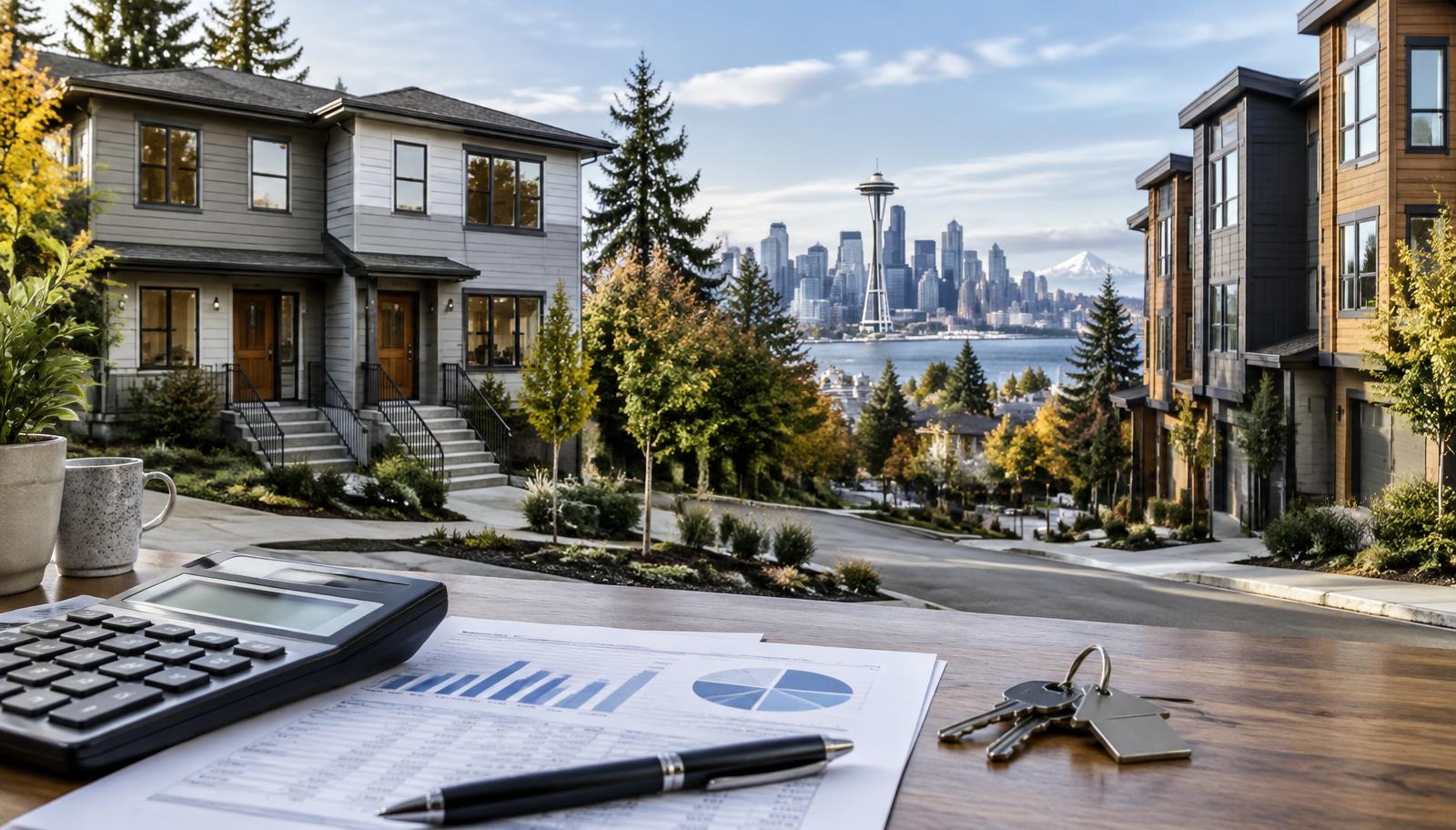
- New Construction Value: In areas like Northgate and West Seattle, new-build townhomes are often priced competitively against older resale homes, offering superior energy efficiency.
Discover Your Dream Home
Don’t wait for the weekend open house. [Browse Maggie Sun’s Exclusive Seattle Listings] to see off-market opportunities and high-value properties before they hit the national portals.
How to Buy a House in Seattle, Washington: Step-by-Step Guide (2026)
A disciplined process is the best way to secure a home in a "Strong" intensity market. According to recent reports, 47% of buyers cite "not knowing the process" as their primary stressor. Following these steps ensures your purchase stays on track. If your goal is to buy a house in Seattle Washington, following a disciplined, step-by-step process is the most reliable way to compete, protect your capital, and avoid costly mistakes.
Phase 1: Financial Preparation Before Buying a House in Seattle
Buying a home in Seattle starts long before touring properties—this phase is about aligning your budget, priorities, and financing with real market constraints. Strong preparation gives you leverage in negotiations and prevents costly surprises once you’re under contract.
Step 1: Define Your Needs – The "Size, Condition, Location" Principle
Before browsing listings, you must align your expectations with market reality.
- The Rule of Three: In competitive markets like Seattle, buyers typically choose two out of three priorities: Size, Condition, or Location. For example, a $900,000 budget might secure a renovated townhouse in a prime area (Location/Condition) or a larger single-family home further out that needs updates (Size/Location).
- Categorize Your List: * Must-Haves: Budget, minimum bedrooms, school district, or a max 30-minute commute.
- Nice-to-Haves: Large yard, modern renovations, or specific orientations.
- Legal Requirement: As of 2024, Washington state law requires buyers to sign a Buyer Agency Agreement before touring homes to establish a professional fiduciary relationship.
Step 2: Secure Pre-Approval – Determining Your Buying Power
A pre-approval letter is your "proof of funds" that tells sellers you are a qualified buyer.
- 2025 Market Context: Mortgage rates currently fluctuate between 6.0% and 6.4%. Your pre-approval is typically valid for 60–90 days.
- Buyer Tiers & Down Payments:
- Primary Residence: 5% – 20% down.
- Investment Property: 25%+ down.
- Foreign Income/New Immigrants: 35% – 40% down with stricter asset verification.
- Tech Professionals: If you work for companies like Amazon or Microsoft, lenders will specifically analyze your RSU vesting schedules to calculate qualifying income.
Phase 2: Home Search and Making an Offer in Seattle
This phase focuses on turning preparation into action by identifying the right homes and submitting offers that are both competitive and well-protected. In Seattle’s balanced 2026 market, strategy matters more than speed alone.
Step 3: Strategic House Hunting – The 15-30 Home Benchmark
Viewing homes is a process of elimination, not just selection.
- The Volume Rule: Most buyers view 15 to 30 homes before finding "the one"8. This volume helps you objectively compare neighborhood values and structural quality.
- Optimal Rhythm: We recommend touring 3–5 homes per session, twice a week, to avoid "house fatigue".
- Inventory Trends: While inventory has increased by nearly 45% recently, well-priced homes in desirable areas still go pending in approximately 25 days.
Step 4: Drafting a Winning Offer – Protecting Your Interests
An offer is a legal contract (Purchase and Sale Agreement) that must balance price with protection.
- Essential Contingencies: In 2025's balanced market, you should rarely waive protections. Ensure your offer includes Inspection, Financing, and Appraisal contingencies.
- Pricing Strategy: On average, Seattle homes sell for 99.1% of the list price. Low-balling is rarely successful, but there is more room for negotiation than in previous years.
Phase 3: Inspections, Appraisal, and Contract Milestones
Once your offer is accepted, the financial and legal clock starts. This phase is designed to uncover risks, verify value, and ensure the home meets both lender requirements and your long-term ownership goals.
Step 5: Mutual Acceptance – The Contract Clock Starts
Mutual Acceptance (MA) occurs when both parties sign the final terms. This is Day 0.
- Earnest Money Deposit (EMD): Within 1–3 business days of MA, you must deposit 3% to 5% of the purchase price into a third-party escrow account.
- Protection: If you exit the deal within your contingency periods (e.g., failed inspection), this money is typically fully refundable.
Step 6: Specialized Inspections – Identifying Hidden Liabilities
Professional inspections protect you from inheriting costly structural issues.
- Costs & Scope: A general inspection costs $500–$800. We strongly recommend a Sewer Scope ($150–$300) to check for root intrusion or pipe collapse, which is common in older Seattle neighborhoods.
- Negotiation: If major issues are found, you can request a Seller Credit (money off your closing costs) or a price reduction rather than asking for physical repairs, which can be unreliable.
Step 7: Appraisal and Underwriting – Final Bank Approval
The bank evaluates both you and the property before releasing funds.
- The Appraisal Gap: If the bank's appraiser values the home at $870k but your contract is for $900k, the bank only lends based on $870k. You must then negotiate a price drop or cover the $30k gap in cash.
- Clear to Close (CTC): This is the final green light from the bank, indicating all income, asset, and property verifications are complete.
Phase 4: Closing on a House in Seattle and Taking Ownership
The final phase ensures every financial detail is correct and the property is delivered as agreed before ownership officially transfers. Careful verification at this stage protects you from post-closing disputes and unexpected costs.
Step 8: Closing Preparation – Verifying the Details
Before signing, you must verify all financial figures.
- The CD Review: Compare your Closing Disclosure (CD) from the bank with the ALTA Settlement Statement from escrow to ensure every dollar is accounted for.
- Final Walk-Through: Conducted 24–48 hours before closing, this confirms the home's condition hasn't changed and that agreed-upon repairs are finished.
Step 9: Closing Day – Receiving Your Keys
Ownership officially transfers once the county records the deed.
- Recording: Once the county issues a Recording Number, you are the legal owner.
- The Handover: You will receive all keys, garage remotes, and mailbox codes from your agent.
2026 Estimated Budget: $1M Home Example
To buy a $1,000,000 home in a market like Washington, you should prepare the following cash reserves:
| Item | Estimated Cost | Notes |
|---|---|---|
| Down Payment (20%) | $200,000 | Includes the EMD already paid |
| Closing Costs (2–3%) | $20,000 – $30,000 | Loan fees, Title/Escrow, Taxes 24 |
| Inspections | $500 – $1,100 | General + specialized scopes 25 |
| Total Cash Needed | ~$220,500 – $231,100 | Varies by loan and tax pre-payments |
10 Best Neighborhoods to Buy a House in Seattle (2026 Guide)
Choosing where to buy a house in Seattle Washington, depends on your lifestyle goals and investment horizon. Below is a comparison of the top 10 neighborhoods based on 2026 market data. For a deeper dive into each area, read our full guide: 10 Best Neighborhoods in Seattle to Buy a House.
| Neighborhood | Vibe | Median Price (2026) | Why It’s a Top Pick |
|---|---|---|---|
| Ballard | Trendy/Maritime | $869,000 | Elite lifestyle-to-equity ratio; prime for DADU development. |
| Queen Anne | Luxury/Classic | $1,250,000 | Prestigious "Postcard Views"; highest value stability in the city. |
| Capitol Hill | Urban/Energy | $895,000 | Elite transit (4 mins to Downtown); high rental demand. |
| West Seattle | Beachy/Suburban | $825,000 | Coastal lifestyle; West Seattle Link Extension is a huge growth driver. |
| Fremont | Arts/Tech Hub | $885,000 | "Center of the Universe"; high profitability for tech-worker rentals. |
| Columbia City | Diverse/Culture | $815,000 | Historic charm; 2026 zoning allows for "unit lot subdivisions." |
| Green Lake | Fitness/Family | $1,080,000 | Outdoor paradise; homes near the lake trail sell within 14 days. |
| Beacon Hill | Value/Pro Hub | $754,950 | Best affordability-to-transit ratio; flat lots reduce DADU costs. |
| Magnolia | Private/Nature | $1,099,000 | Safest urban neighborhood; large lots for high-end guest houses. |
| Ravenna | Academic/Quiet | $870,625 | Proximal to UW; elite school district anchors property values. |
Is Buying a House in Seattle a Good Investment in 2026?
The 2026 investment landscape in Seattle is no longer defined by simple house-flipping, but by density-driven equity. On January 21, 2026, the city officially transitioned from "Single-Family" to "Neighborhood Residential" (NR) zoning. This policy shift has unlocked "invisible" value in thousands of residential lots across the city.
If you are looking to buy a house in Seattle, Washington as a long-term asset, you must evaluate properties through the lens of the "One Seattle" framework:
- The Four-Unit Standard: Any standard residential lot now permits up to four units. Investors are currently targeting older bungalows on large lots to convert them into high-density triplexes or fourplexes, significantly increasing the property’s cash-flow potential.
- Transit-Oriented Density (TOD) Bonuses: Properties within a quarter-mile of Link Light Rail stations (such as those in Columbia City or Northgate) are eligible for up to six units. This "transit-premium" ensures high rental demand and superior resale value.
- Unit Lot Subdivisions (The Exit Strategy): Unlike previous years, 2026 laws allow for "Unit Lot Subdivisions." This means you can build a backyard cottage (DADU) and sell it as a separate parcel, allowing you to recoup construction costs immediately while retaining the primary residence.
The Maggie Sun Investment Filter: We analyze the "Floor Area Ratio" (FAR) of every listing to determine if the lot is under-utilized. Our goal is to find you a home that doubles as a development site.
Common Mistakes to Avoid When Buying a House in Seattle, Washington
In a market with high-rated properties, "premium" doesn't just refer to quartz countertops; it refers to structural resilience. Seattle’s unique climate and geography create specific liabilities that can cost an unprepared buyer tens of thousands of dollars.
To safely buy a house in Seattle Washington, you must avoid these three common "Emerald City" pitfalls:
1. Ignoring Seismic Risk: Foundation and Earthquake Safety in Seattle
Seattle sits in a high-risk seismic zone. Many of the city's charming 1920s Craftsman homes were not originally bolted to their foundations.
- The Problem: During an earthquake, an unbolted house can slide off its foundation, leading to a total loss.
- The Solution: We verify the presence of foundation bolts and earthquake straps. If they are missing, we help you negotiate a seller credit (typically $5,000–$8,000) to perform a seismic retrofit immediately after closing.
2. Underestimating Moisture Risk: Rain-Screen, Drainage, and Rot Issues
With 38+ inches of annual rainfall, moisture is the primary enemy of Seattle real estate.
- The Problem: Poorly installed "rain-screen" siding or failed chimney flashing leads to "blind rot"—structural decay that isn't visible during a standard walkthrough.
- The Solution: We look for 6-mil vapor barriers in crawlspaces and dehumidification systems in basements. A home without a modern drainage system or "French drains" on a sloped lot is a high-risk asset.
3. Skipping a Sewer Scope Inspection: A Common $20,000 Repair Risk
Seattle’s mature tree canopy is beautiful, but it is lethal to aging clay sewer pipes.
- The Problem: Root intrusion can cause a sewer collapse under the street, which is a homeowner's financial responsibility in Seattle.
- The Solution: We consider a professional Sewer Scope mandatory. Identifying a "belly" or root blockage during the inspection allows us to demand repairs from the seller before you are legally committed to the deed.
Conclusion
If your goal is to buy a house in Seattle Washington in 2026, the market conditions reward the prepared. Success requires a combination of sophisticated financial planning (RSUs), hyper-local neighborhood knowledge, and an understanding of new density laws. With over a decade of local expertise, the Maggie Sun Real Estate Group is here to ensure you don't just find a house, but secure a resilient, high-value investment.
Practical Tips for 2026 Buyers:
- Verify your RSUs Early: Ensure your lender understands total compensation packages.
- Audit for Resilience: Always confirm "Rain & Shake" readiness during the inspection period.
- Consult an Expert: [Schedule a Free 15-Minute Strategy Call with Maggie Sun] to map out your 2026 buying plan.
FAQs of Buying a Home In Seattle, WA.
What is the median cost to buy a house in Seattle, Washington right now?
As of late 2025, the median residential sales price in Seattle proper is approximately $900,000.This is a 4.05% increase from the previous year, showing steady growth despite higher interest rates. If you look at the Eastside, including Bellevue and Redmond, the median price jumps significantly to $1,455,000. Condos offer a more affordable entry point with a median price of $686,359.14
Can I use my RSU income to qualify for a mortgage in Seattle?
Yes, most lenders in the Seattle metropolitan area are experienced with tech sector compensation. You can typically use RSU income if you have at least a two-year history of vesting with the same employer. Lenders will review your vesting schedule and tax returns to ensure the income is stable. This is essential for tech professionals who want to maximize their borrowing power in high-cost neighborhoods.
How has the 2025 estate tax change affected Seattle real estate?
Effective July 2025, the Washington state estate tax exemption was raised to $3 million. While this helps many families, the top tax rate for large estates increased from 20% to 35%. This change has prompted many wealthy residents to reconsider their residency or property locations. Buyers of luxury homes now often use irrevocable trusts to manage their taxable estate and protect their heirs.
Is it currently a buyer's or seller's market in Seattle?
Seattle is currently in a "Strong" market intensity phase, which leans toward sellers but offers more buyer leverage than in 2024. With 2.23 months of inventory, buyers have more choices and more time to conduct inspections. Homes are sitting on the market longer, averaging about 27 to 54 days depending on the specific metro area. This shift allows for more thoughtful negotiations and fewer waived contingencies.
Is 2026 a good time to buy a house in Seattle, Washington?
Yes. Following the "Great Recalibration" of 2025, inventory is up 23%, giving buyers more choice and negotiating power than any time in the last decade.
How do I start the process to buy a house in Seattle Washington?
Start with a financial audit. For tech workers, this means verifying how your RSU vesting schedule will impact your down payment and monthly mortgage qualification.
What is the average closing time in Seattle?
With an experienced team like Maggie Sun, we typically close in 21 to 25 days, which is a major competitive advantage in multi-offer situations.
Can I build more than one unit on a Seattle lot now?
Yes. Under the 2026 "One Seattle" laws, most residential lots now allow for up to four units, providing significant equity upside.
Which neighborhood is best for tech commuters?
Capitol Hill and SLU offer the best proximity, while neighborhoods along the Link Light Rail (Beacon Hill, Columbia City) offer the best "transit-to-value" ratio.