Published: April 8, 2026 | Author: Maggie Sun | Read Time: 8 min
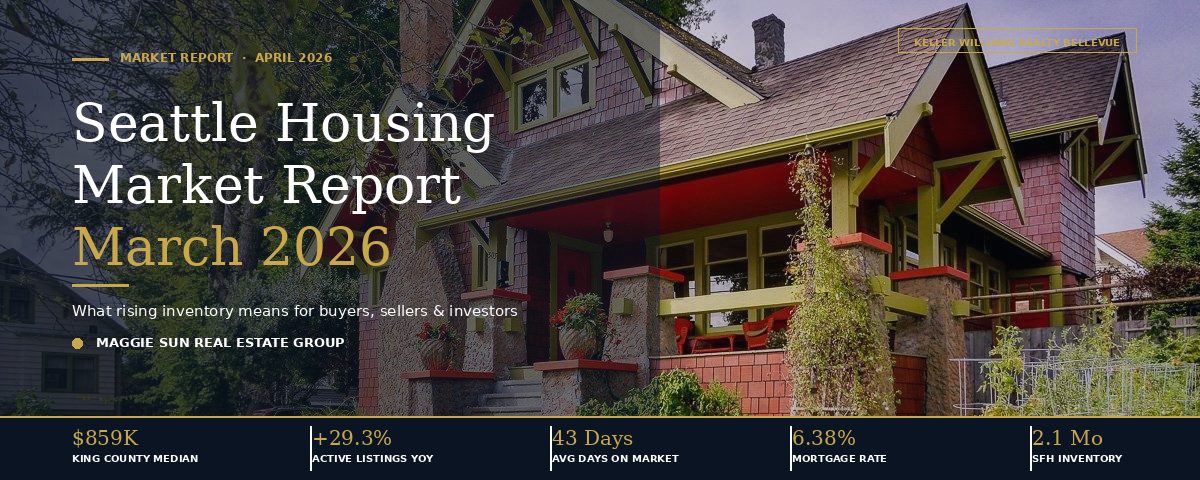
Seattle Housing Market Report March 2026
Spring arrived in Seattle with more homes on the market than buyers have seen in years — yet prices haven't collapsed. The Seattle housing market in March 2026 is rebalancing, not retreating, and that nuance matters enormously depending on which side of a transaction you're on.
If you've been watching the market from the sidelines, March's data gives you the clearest picture in years. Inventory surged 36.1% year-over-year. Days on market stretched to 43 days. And mortgage rates, after a brief dip below 6% in late February, climbed back to 6.38% by month's end. At the same time, well-priced single-family homes in desirable neighborhoods are still selling above ask — some with multiple offers.
This is not a buyer's market or a seller's market. It's a property-type market: your negotiating power depends almost entirely on what you're buying or selling. Read on for the full breakdown.
"Seattle is no longer a speed-driven market — it's a pricing-driven market."
"In 2026, overpricing is riskier than underpricing in Seattle."
"Inventory is rising faster than demand, but not enough to trigger a price correction."
More choices, but not a buyer's free-for-all — Seattle's spring 2026 market rewards preparation over patience.
Is Seattle a Buyer's or Seller's Market in 2026?
As of March 2026, the Seattle housing market is best described as a split or "property-type market" rather than purely buyer- or seller-driven. Single-family homes remain seller-favored with tight inventory (~2.1 months) and homes still selling at 101.1% of list price. Meanwhile, condos and new construction have shifted toward buyers, with 4.4–4.7 months of supply giving buyers meaningful room to negotiate on price, concessions, and closing terms.
This divergence is the defining feature of the Seattle real estate market in 2026. Understanding which segment your target property falls into is more important than any single data point — and it determines your entire negotiation strategy before you even make an offer.
Seattle Housing Market Snapshot — March 2026
Here are the headline numbers drawn from the NWMLS March 2026 Market Snapshot, supplemented by data from Redfin, Zillow, and The Madrona Group, covering greater Seattle and King County.
| Indicator | Value | Note |
|---|---|---|
| King County Median Sale Price | $859,618 | March 2026 |
| Active Listings YoY (WA State) | +29.3% | ↑ More supply |
| Closed Sales YoY | +0.2% | Demand steady |
| Avg Days on Market (Seattle) | 43 days | ↑ 16% vs Feb |
| Avg Mortgage Rate (end of March) | 6.38% | ↑ From sub-6% low |
| Sales Activity Intensity™ | 45.6% | Strong |
| Avg Showings Before Pending | 16 | ↓ 22% vs prior year |
The statewide median price fell 1.5% year-over-year to $640,000 (KING5 / NWMLS), but Seattle proper and King County tell a more nuanced story. At the city level, single-family homes are still trading above $1 million — a floor that has proven remarkably durable.
How March 2026 Compares to Early 2025
Compared to March 2025, the Seattle housing market has shifted materially — not in price, but in the balance of power between buyers and sellers. For full context on where the market stood a year ago, see our 2025 market recap. Here's how the key indicators have moved:
| Indicator | March 2025 | March 2026 | Change |
|---|---|---|---|
| Active Listings (WA State) | ~11,600 | 15,049 | +29.3% YoY |
| Closed Sales (WA State) | baseline | +0.2% YoY | Flat |
| WA State Median Price | ~$650,000 | $640,000 | −1.5% YoY |
| King County Median | ~$840,000 | $859,618 | +2.3% YoY |
| Avg Days on Market (Seattle) | ~37 days | 43 days | +16% |
| Snohomish Co. Inventory | baseline | +51.8% YoY | Significant surge |
The divergence between supply and demand is the defining story of this comparison. Inventory is climbing at nearly 30x the rate of closed sales. That gap signals a shift from the supply-constrained, panic-buying conditions of 2022–2024 toward a more deliberate, negotiation-driven market — where preparation and pricing discipline matter far more than speed.
Crucially, this trend doesn't mean prices are collapsing. King County values actually rose ~2.3% year-over-year, even as broader statewide numbers softened slightly. Seattle's structural supply ceiling continues to prevent the kind of broad correction seen in other overbuilt metros.
Condos vs. Single-Family Homes: Two Very Different Markets
The most important insight in the Seattle real estate market in 2026 isn't the headline median — it's the split between property types. These two segments are behaving in opposite directions:
| Metric | Single-Family (Resale) | Condos | New Construction |
|---|---|---|---|
| Avg Sale Price | $1,060,000+ | +3.4% YoY avg | ~$1,010,000 |
| Months of Inventory | 2.1 months | 4.4 months | 4.7 months |
| Sale-to-List Ratio | 101.1% (above ask) | At or slightly below ask | Negotiable |
| Buyer Leverage | Low — seller-favored | Moderate — buyer-favored | Moderate-High |
Why Single-Family Homes Are Still Holding Strong
Seattle's geography is its destiny. Hemmed in by Puget Sound and the Cascades, the city simply cannot sprawl. That constraint keeps the supply of detached single-family homes perpetually tight. With only 2.1 months of inventory, well-prepared buyers for SFH still face competition — especially in neighborhoods like Ballard, North Seattle, and Queen Anne, where turnkey homes regularly attract multiple offers.
Why the Condo Market Has More Breathing Room
At 4.4 months of supply, the condo segment has crossed into balanced — nearly buyer-favorable — territory. Rising HOA fees, remote work reducing the "walkable commute" premium, and more new condo projects hitting the market are all contributing factors. For buyers considering condos in Capitol Hill, the Central District, or South Lake Union, this is the most negotiating room they've had in years. See our condo buyer's guide for what to watch out for.
Agent Perspective — Maggie Sun
"I'm telling every buyer right now: if you want a turnkey single-family home in a top Seattle school district, don't wait. That segment is still competitive. But if you're flexible on property type, the condo market has genuinely shifted in your favor — and sellers are much more open to repair credits, rate buydowns, and extended closing timelines than they were 18 months ago."
🔍 On the Ground: Local Expert Insights — Last 30 Days
1. North Seattle · Pre-Inspection Shift
In the past 30 days, 4 out of 6 single-family listings we toured in North Seattle had a seller-prepared pre-inspection report waiting at the open house. Only 2 of those homes actually received multiple offers. Pre-inspection alone no longer guarantees a bidding war — but skipping it still hurts you in the offer comparison. Sellers are doing more of the legwork, and buyers are responding with more scrutiny, not more urgency.
2. Capitol Hill · Condo Concessions Are Real
We recently helped a buyer negotiate $18,000 in seller concessions on a Capitol Hill condo — including a one-year HOA fee credit and a full home warranty. The listing had been sitting for 34 days. Twelve months ago, that conversation wouldn't have started; sellers would have moved to the next offer. Today, patient buyers in the condo segment are getting deals that simply weren't on the table in 2024.
3. Rate Window · The 10-Day Opportunity
When rates briefly dipped below 6% in late February, our inbound buyer inquiries nearly doubled in a single week. Most of those buyers didn't end up locking — by the time they completed pre-approval paperwork, rates had already climbed back to 6.2%. The window was real, but it closed in under 10 days. The lesson: buyers who aren't pre-approved and rate-alert are consistently missing these brief openings.
4. Eastside · Light Rail Is Already Moving Buyers
Since the East Link March 28 opening was confirmed, we've tracked a noticeable uptick in South Bellevue and Bellevue buyer tours from clients who work in the International District and SoDo. Two families specifically told us the new commute made a $200,000–$300,000 higher price point feel justifiable compared to staying in Seattle. That shift hasn't shown up in closed-sale data yet — but it will by Q3.
Inventory, Demand & Negotiating Power in March 2026
New listings jumped 25.5% month-over-month, and total active listings rose 36.1% year-over-year (The Madrona Group). To put that in perspective: more choices for buyers than at any point since 2019. And yet, demand hasn't evaporated.
- Showings rose 19% from February, and keybox accesses jumped 24.5% — spring foot traffic is real.
- The Sales Activity Intensity™ sits at 45.6%, indicating that roughly half of all listed homes are attracting serious buyer attention.
- Homes are averaging 16 showings before going under contract, down from historic highs but still meaningful.
- Snohomish County saw inventory spike 51.8% year-over-year — a meaningful spillover from Seattle affordability pressure. Buyers priced out of Seattle should explore our list of affordable suburbs.
⚠️ Demand Warning Signal
Despite the uptick in showings, those figures still lag behind March 2025 levels. The seasonal bounce is happening, but it isn't translating into sales at the same rate as last year. Overpriced listings are sitting. The gap between what sellers want and what buyers will pay is the defining tension of this market.
The Rate Whiplash Effect
Mortgage rates dipped below 6% at the very end of February — the first time since September 2022. That brief window sparked real buyer excitement. But by late March, rates had climbed back to 6.38%, driven partly by renewed global uncertainty. For a $900,000 home with 20% down, the difference between 5.9% and 6.4% is roughly $270/month. That swing re-shelved some buyers who were just getting ready to act.
What March 2026 Means for Real Buyers & Sellers
Scenario 1 — The Relocating Tech Family
Moving from Bay Area, budget $1.2M
This family is actually in the best position they've been in for years. More inventory means they're not forced into a bidding war on the first house they see. With 43 average days on market, they can actually take a weekend to think it over. Still weighing the move? Our should I move here? guide covers the full picture. The new South Bellevue–to–International District light rail connection opening March 28 also expands their neighborhood options — living in Bellevue while working in Seattle just got faster and more viable.
Scenario 2 — The First-Time Buyer
Budget $600K–$750K, considering condos
The condo market is finally working in their favor. With 4.4 months of supply in that segment, they can ask for concessions — seller-paid closing costs, a rate buydown, or a home warranty — and actually get them. The catch? Rates at 6.38% mean their monthly payment is still steep. Down payment assistance programs and careful rate-lock timing (watching for dips) will be critical to closing successfully.
Scenario 3 — The Real Estate Investor
Looking at rental-income properties
Seattle rents remain elevated at $3,300–$3,700/month for larger homes (Madrona Group), meaning the rent-vs-buy equation still strongly favors renting for many residents — and that means sustained tenant demand for investors. Wondering if the numbers pencil out? Our guide on good investment? breaks down the math. Institutional investors are already noticing: Redfin reported Seattle investor home purchases jumped 37% year-over-year in Q4 2025 (Redfin), the largest increase among major US metros. New construction condos with 4.7 months of inventory offer room to negotiate purchase price, potentially improving cap rates in a way that wasn't possible two years ago.
Pros & Cons of Buying or Selling in Seattle Right Now
Should You Buy a Home in Seattle in 2026?
| ✅ Pros of Buying Now | ❌ Cons of Buying Now |
|---|---|
| 36%+ more inventory — more real choices | Rates back to 6.38% — affordability a challenge |
| Condo segment is negotiable | SFH still competitive — multiple offers in good areas |
| Days on market have lengthened — less panic pressure | Capital gains tax & tech layoffs creating uncertainty |
| New light rail expands viable neighborhoods | King County median near $860K — big down payment needed |
| Prices forecast flat-to-modest — no need to time a dip | |
| Seller concessions (rate buydowns, repairs) are back |
Should You Sell Your Seattle Home Right Now?
| ✅ Pros of Selling Now | ❌ Cons of Selling Now |
|---|---|
| Spring foot traffic active (showings +19% from Feb) | Competition: new listings up 25.5% — must stand out |
| SFH still selling at 101.1% of list price | Overpricing is fatal — buyers are patient and informed |
| Equity position remains strong for long-term owners | 43 avg days on market — plan further ahead |
| Getting ahead of potential summer softening — see our best time to sell guide | Condo & new construction sellers face real price pressure |
💡 Seller Insight
The sellers succeeding right now are those pricing for today's market, not 2021. A home priced correctly from day one generates urgency and multiple offers within the first two weekends. A home priced 5–8% too high sits for 60+ days and ultimately sells for less than a well-priced listing would have from the start.
Neighborhood-by-Neighborhood: Where the Market Is Hottest
Seattle's housing market has always been hyperlocal, and March 2026 is no exception. Here's a quick pulse check by area:
- Ballard / Phinney / Greenwood: Turnkey homes still draw multiple buyers. Projects and fixer-uppers have more room to negotiate.
- West Seattle: Demand remains healthy but buyers are increasingly price-sensitive. Bridge access improvements have helped.
- Capitol Hill / Central District: Condo inventory gives buyers real leverage. Great entry-point market for first-time buyers this year.
- North Seattle (Wedgwood, Maple Leaf, Roosevelt): Family homes in good school districts continue to see steady demand and competitive offers.
- Queen Anne / Magnolia: Well-presented homes perform strongly. But buyer expectations — and scrutiny — are high at this price point.
- South Bellevue / Eastside: The new light rail connection is a real wildcard — explore the full Bellevue vs Seattle comparison for buyers weighing both sides of the lake.
📍 Explore our best neighborhoods guide for deeper area profiles.
What to Expect in the Next 3–6 Months
April – May 2026
Prime spring selling season. Expect inventory to keep climbing as more sellers who deferred in 2025 finally list. Well-priced homes in popular neighborhoods will still move fast. Buyers who have financing locked and can move quickly will have the clearest advantage.
June – July 2026
If mortgage rates ease back toward 6.0% or below (Mortgage Bankers Association forecasts this as possible by mid-year), expect a meaningful surge in buyer demand. If rates stay elevated, the market will continue its slow-motion rebalancing with selective competition in the SFH segment.
Light Rail Impact (Q2–Q3)
The March 28 South Bellevue–International District connection is still too new to show up in closed sales data, but agent-level activity near East Link stations is already increasing. South Bellevue, Mercer Island, and Bellevue city center are likely to see the most measurable price support from improved commute access. See our 2026 outlook for the broader forecast.
Macro Watch: Tech Sector & Tax Policy
Washington's capital gains tax and ongoing discussions around a broader state income tax are influencing where high-earning buyers choose to settle. Some are looking at Idaho, Nevada, or Texas. Continued tech-sector job fluctuations at Amazon, Microsoft, and adjacent firms remain the largest single macro variable for Seattle housing demand through 2026.
12-Month Outlook
Home prices in Seattle are forecast to grow a modest 2–4% through 2026. A crash is not on the horizon — Seattle's structural supply constraints, strong homeowner equity, and resilient (if slower-growing) tech economy provide a durable floor. But the days of 10–15% annual appreciation are behind us for this cycle. This is a market where strategy beats timing.
The Bottom Line on Seattle's March 2026 Market
The Seattle housing market in March 2026 rewards preparation and penalizes complacency — on both sides of the transaction. Buyers have more choices than they've had in years, but must be ready to act quickly when the right single-family home appears in a competitive corridor. Sellers who price strategically and present well are still finding strong demand. Those who overprice are sitting.
The next 90 days will be shaped by where mortgage rates land, how the tech sector stabilizes, and whether the spring buyer rush translates into meaningful sales volume. All signs point to an active, selective, and increasingly buyer-aware Seattle real estate market heading into summer.
Have questions about your specific situation? Find a top agent or reach out to our team directly.
FAQ: Seattle Housing Market — March 2026
Q: Is the Seattle housing market slowing down in 2026?
It's more accurate to say the market is rebalancing. Inventory is rising significantly (up 36% YoY), days on market are lengthening, and buyer leverage is improving — especially for condos and new construction. However, well-priced single-family homes in desirable neighborhoods are still selling above list price. It's not a slowdown so much as a sorting: quality wins, and overpricing fails.
Q: Will Seattle home prices drop in 2026?
A broad price crash is unlikely. The structural constraints on Seattle housing supply — geography, zoning, and limited buildable land — provide a long-term price floor. The consensus forecast is for flat-to-modest growth of 2–4% for 2026. Condos and new construction may see mild price pressure, while single-family homes should hold their value in most neighborhoods.
Q: What is the median home price in Seattle in March 2026?
King County median sale prices reached approximately $859,618 in March 2026. Within the city of Seattle proper, single-family resale homes average just over $1,060,000, while condos have seen average prices rise ~3.4% year-over-year. The broader Washington state median was $640,000. For a deeper look, see our median home price tracker.
Q: Is it a good time to buy a home in Seattle in 2026?
For many buyers, yes — especially if you're targeting condos or new construction, where inventory has risen to 4.4–4.7 months of supply and sellers are more willing to negotiate. For single-family homes, it's still competitive. The best time to buy is when you're financially ready and have found the right property. Waiting for a big price drop in Seattle's SFH market could mean missing good inventory now. Our Seattle buyer's guide walks through every step.
Q: How are mortgage rates affecting the Seattle market in 2026?
Significantly. Rates briefly dipped below 6% at the end of February, sparking buyer interest — but they climbed back to 6.38% by late March. That swing of nearly half a percentage point adds roughly $270/month to a typical Seattle home purchase. Buyers need to monitor rate windows carefully and work with a lender who can lock quickly when opportunities arise.
Q: What neighborhoods in Seattle are best for buyers in 2026?
Capitol Hill and the Central District offer the most buyer leverage right now, with condo inventory giving room to negotiate. North Seattle neighborhoods like Wedgwood, Maple Leaf, and Roosevelt are popular for families due to strong school districts. The Eastside — particularly near new East Link light rail stations — is an emerging area to watch as commute patterns shift. See our full best neighborhoods guide.
Q: How does the new light rail extension affect Seattle real estate?
The March 28 opening of the South Bellevue–to–International District East Link segment is a genuine market event. It meaningfully reduces cross-lake commute times and may expand the geographic consideration set for buyers — making South Bellevue, Mercer Island, and Bellevue's downtown core more attractive to Seattle workers. Historically, light rail openings correlate with a 5–15% price premium near station areas within 18–24 months of opening.
📋 Data Sources
- Northwest Multiple Listing Service (NWMLS) — March 2026 Market Snapshot (published April 2026)
- The Madrona Group — Seattle Housing Market Report, March 2026
- Redfin — Seattle, WA Housing Market Data (February–March 2026)
- Zillow — Seattle, WA Home Values & Market Trends, 2026
- KING5 News — Seattle-area housing inventory surges, March 4, 2026
- George Moorhead Group — Seattle WA 2026 Housing Market Report
Maggie Sun | Realtor® · Keller Williams Realty Bellevue · Seattle & Eastside Market Specialist maggiesunre.com | Contact Us
Maggie Sun
Managing Broker | Buy, Sell & Invest Seattle & Bellevue | Maggie Sun Real Estate Group
or another way